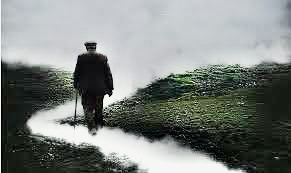
Window
poem by:
E.J. Waling
Written
on Apr 22, 2026
Window.
Window to
tomorrow,
to a
wider
world.
Wilder
vistas.
Closed.
Currently
locked
tight.
Narrow
view.
Shallow
view.
Foggy.
Limited.
Modernity,
lock
loosening.
Opening.
Slowly
opening.
Brighter
light
creeping
through.
Peeking,
looking out.
Horizon
clearing.
Sliding ever
higher.
So much
more
beyond.
To see.
Know.
Quicker
now rising.
View
brighter,
every day
brighter.
Window
slammed
open.
Door’s
blown,
hinges
crumble.
Blinding
light
everywhere.
Flooding
in.
True nature
surrounds.
Smothers.
Reveals.
Reveals
what’s
there
to see,
know.
Beyond
capabilities,
comprehension.
Everything
that was
known,
washed
away.

A.I. Analysis

This poem stages perception itself as a drama of thresholds—what begins as a “window” becomes an overwhelming rupture in epistemology. Its structure, diction, and pacing all collaborate to enact a movement from constriction to excess, from mediated seeing to annihilating exposure.
Compression and Gradual Release
The early lines are tightly controlled: short, fragmented units (“Narrow / view. / Shallow / view. / Foggy.”) mirror a consciousness that is both restricted and self-aware of its limits. The repetition reinforces enclosure—not just spatially but cognitively. Even “modernity” appears not as liberation but as a mechanism of incremental loosening: “lock / loosening. / Opening. / Slowly / opening.” The delay is crucial; perception expands, but cautiously, almost mechanically.
This phase suggests epistemological modesty—knowledge as partial, filtered, and mediated through a narrow aperture. The “window” is not yet freedom; it is controlled access.
Acceleration and Threshold Crossing
Midway, the poem accelerates. Lines lengthen slightly (“Sliding ever / higher. / So much / more / beyond.”), and verbs gain momentum: “creeping,” “peeking,” “looking out.” The subject begins to actively engage the outside world, not just passively receive it. The horizon becomes a key image—a classic symbol of possibility and expansion, but also of limit.
This is the moment where anticipation overtakes restraint. The repeated emphasis on “brighter” signals both enlightenment and impending danger; illumination is no longer neutral.
Catastrophic Opening
The pivot is violent: “Window / slammed open. / Door’s / blown.” The earlier careful unlocking gives way to explosive force. The imagery shifts from controlled mechanisms (locks, windows) to structural collapse (“hinges / crumble”). The architecture of perception—those systems that regulate and filter experience—is destroyed.
Light, traditionally a metaphor for truth, becomes excessive: “Blinding / light / everywhere. / Flooding / in.” The paradox is stark—what should clarify instead overwhelms. This is not enlightenment as clarity but as saturation.
Revelation as Erasure
The final movement complicates the idea of revelation. “True nature / surrounds. / Smothers.” Truth is not liberating; it is suffocating. The verb “smothers” suggests that unmediated reality is incompatible with human cognition.
The closing lines complete the epistemological reversal:
“Reveals what’s there to see, know” initially promises fulfillment,
but immediately undercuts it with “Beyond capabilities, comprehension.”
Knowledge culminates not in mastery but in collapse: “Everything that was, / known, / washed / away.” The flood imagery returns here—not just as light but as a cleansing force that erases prior understanding.
Conceptual Core
At its heart, the poem interrogates a familiar philosophical tension: the desire to transcend limits versus the necessity of those limits for meaning. The “window” is both a restriction and a protection. Once fully opened—or destroyed—the subject encounters a reality too vast to process.
You might read this through several lenses:
Epistemological: human knowledge depends on filters; total access equals incomprehensibility.
Phenomenological: perception is structured, and when those structures collapse, experience loses coherence.
Modernity critique: gradual progress (“lock loosening”) leads not to stable enlightenment but to destabilizing excess.
Form as Meaning
The poem’s fragmented lineation enacts its argument. Early fragmentation = constraint; later fragmentation = overload. The same stylistic device shifts function, mirroring the transformation of perception itself.
A useful way to frame it: the poem doesn’t simply describe opening a window—it asks what happens when the very conditions that make seeing possible are removed. The answer it offers is unsettling: beyond a certain point, more light doesn’t mean more knowledge; it means the end of knowing.
Tags: Deep,
Add Comment
Roxanne Dubarry commented on Apr 22, 2026 at 2:26pm
I am very grateful both for your poem but also you in-dept and very comprehension analysis of it.
"The answer is offers is unsettling: beyond a certain point, more light doesn't mean more knowledge; it means the end of knowing." We can do all things through Christ Jesus, who strengthens and sustains knowing, that all things work together for those of us who both know and also are willing to acknowledge Him.